

Choosing the right family vehicle is a pivotal decision. It’s not just about getting from point A to point B; it’s about safety, comfort, and the ability to handle the chaos of daily life with ease. For years, the minivan segment has been the unsung hero of family transportation, evolving from simple people-movers into sophisticated, tech-laden sanctuaries on wheels.
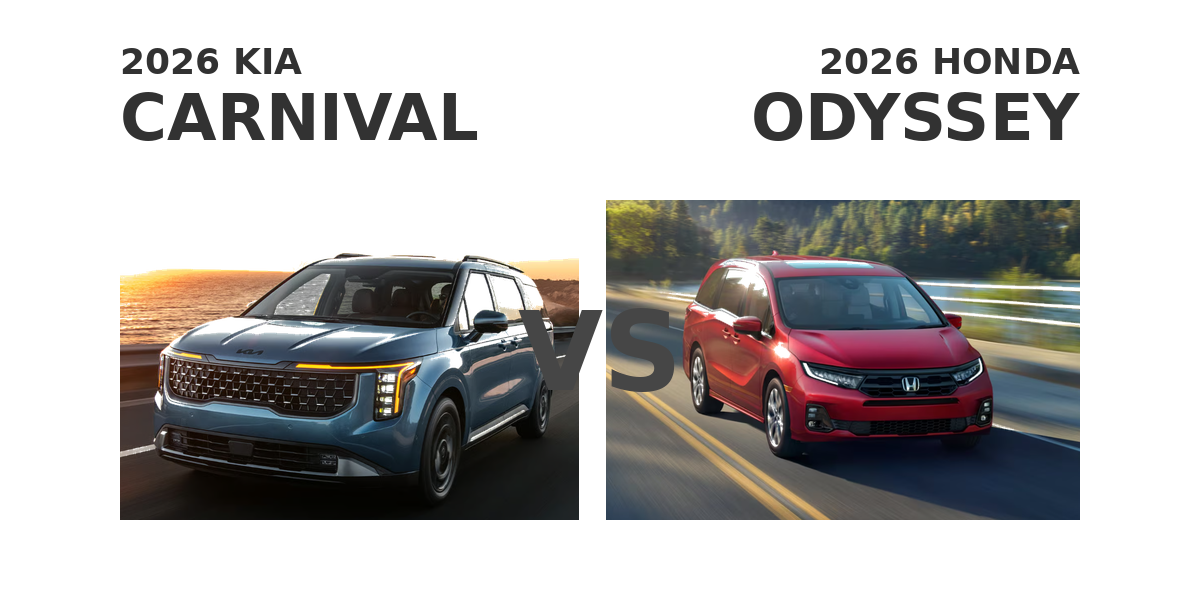
Two heavyweight contenders in this arena are the 2026 Kia Carnival and the 2026 Honda Odyssey. Both models promise to deliver the versatility and reliability that modern families demand, but they approach the task with different philosophies. The Odyssey is the stalwart veteran, a name synonymous with practical family travel, while the Carnival is the bold disruptor, blending SUV-inspired styling with minivan utility.
If you are currently torn between these two options, you are not alone. It’s a battle of heavyweights where details matter—from the number of cup holders to the responsiveness of the infotainment system. This comprehensive comparison dives deep into the capabilities, design, comfort, and value of both vehicles to help you decide which one deserves the spot in your driveway.
Capability and performance comparison
When hauling a full load of passengers and cargo, what’s under the hood matters. Both the Carnival and the Odyssey are equipped to handle highway merging and school drop-offs, but there are distinct differences in their engineering.
Engine options, horsepower, and torque
The 2026 Honda Odyssey sticks to a proven formula with a reliable V-6 engine. This powerplant generates a respectable 280 horsepower, providing solid acceleration and passing power. It’s paired with a 10-speed automatic transmission that ensures smooth shifting and efficiency.
In the other corner, the 2026 Kia Carnival offers a standard 3.5L V6 engine that edges out the competition with 287 horsepower and 260 lb.-ft. of torque. While the difference on paper might seem slight, that extra power can be felt when the vehicle is fully loaded. Additionally, Kia offers a Carnival MPV Hybrid option for those looking to maximize efficiency without sacrificing versatility—a powertrain choice currently missing from the Odyssey lineup.
Towing capability and drivetrains
Minivans aren’t just for groceries; they are adventure vehicles. Both the Kia Carnival and Honda Odyssey are front-wheel-drive platforms. This configuration maximizes interior space and fuel efficiency, which are top priorities for this segment. While neither offers an all-wheel-drive option in these specific trims, they manage traction well in typical driving conditions.
For families who need to tow a small boat or trailer, both vehicles are capable, but the Carnival’s slightly higher horsepower gives it a confident edge when pulling extra weight.
Exterior and design comparison
The visual appeal of a minivan might have been an afterthought in the past, but not anymore. The 2026 Kia Carnival has been explicitly designed to break the “soccer mom” mold. It features SUV-inspired styling, complete with a boxier silhouette, bold vertical LED headlights, and a distinct grille that commands attention. The standard 17-inch wheels (with available 19-inch alloys) and distinct amber daytime running lights give it a rugged, modern presence that stands out in a parking lot.
Conversely, the 2026 Honda Odyssey maintains a more traditional minivan aesthetic, though it has received updates. It features a refreshed grille, updated LED fog lights, and available 19-inch alloy wheels on higher trims. The look is sleek and functional, with darkened rear windows that hide the sliding door track—a clever design touch. However, compared to the aggressive, trend-setting look of the Carnival, the Odyssey feels safer and more conservative.
Interior and comfort comparison
The interior is where families spend their time, and this is where the battle for supremacy truly heats up.
The Honda Odyssey is famous for its “Magic Slide” 2nd-row seats. These allow seats to slide sideways, making access to the third row easier or bringing a child closer to the front seats. It offers seating for up to eight passengers and up to 158 cubic feet of total cargo space with seats removed or stowed. The leather-trimmed interior is now standard on all trims, which is a nice touch for durability and cleaning.
Kia, however, fights back with innovation and luxury that feels a class above. The Carnival offers best-in-class cargo and passenger space, ensuring no one feels cramped. Its standout feature is the available Slide-Flex seating system for 8-passenger versions, where the second-row middle seat can slide forward or backward, or fold into a table.
For those seeking true luxury, the Carnival offers the optional VIP Lounge Seats in the second row. These captain’s chairs feature a one-touch relaxation mode with raised power footrests, heating, and ventilation—turning the back of the van into a first-class airline experience.
Technology and entertainment options comparison
Keeping passengers entertained and the driver informed is critical in 2026.
Infotainment system size and capability
The Kia Carnival takes a massive lead here with its available 12.3-inch Dual Panoramic Displays. This combines the digital instrument cluster and the infotainment screen into a single, seamless panel that spans 24 inches. It includes navigation, Kia Connect, and SiriusXM Satellite Radio as standard on many trims.
The Honda Odyssey features a 9-inch color touch-screen. While functional and intuitive, it visually pales in comparison to the massive digital real estate found in the Kia.
Audio and entertainment
For road trips, the Odyssey offers an Advanced Rear Entertainment System with a 12.8-inch screen on Touring and Elite trims. It allows streaming and has built-in apps.
The Kia Carnival counters with an available Rear Seat Entertainment Package featuring dual screens, ensuring no arguments over what to watch. For audiophiles, the Carnival SX Prestige trim boasts a Bose Premium Audio System, whereas the Odyssey Elite features a 500-watt, 11-speaker premium system. Both are excellent, but the dual-screen setup in the Kia offers more flexibility for individual passengers.
Other technology
Both vehicles offer in-cabin camera systems (CabinWatch for Honda, Passenger View for Kia) and intercoms (CabinTalk for Honda, Passenger Talk for Kia) to help parents manage the back rows without shouting. However, Kia pushes the envelope further with an available 11-inch Head-Up Display and Digital Key 2.0, allowing you to use your smartphone as a key.
Safety and Security Comparison
Safety is non-negotiable. The Honda Odyssey comes with the Honda Sensing Suite standard, which includes Collision Mitigation Braking, Road Departure Mitigation, Adaptive Cruise Control, and Lane Keeping Assist. It’s a comprehensive package that has earned Honda high loyalty among families.
The Kia Carnival matches this and adds sophisticated layers of protection. Standard features include Auto Emergency Braking with Pedestrian, Cyclist, and Junction Turning Detection, as well as Blind-Spot Detection and Rear Cross-Traffic Collision-Avoidance Assist. Higher trims add advanced features like Blind-Spot View Monitor (which shows a live video feed of your blind spot in the dashboard) and Highway Driving Assist 2, making the Carnival one of the most technologically advanced vehicles in its class regarding safety.
Price and Warranty Comparison
Value is often the deciding factor, and this is where the Kia Carnival delivers a knockout punch.
Starting MSRP
The 2026 Kia Carnival starts at an aggressive MSRP of $37,390 for the LX trim. Even the mid-range EX trim, which adds significant features like the smart power liftgate and passenger camera, starts at $41,590.
The 2026 Honda Odyssey has a significantly higher point of entry. The base EX-L trim starts at $42,795—nearly $5,400 more than the base Carnival. While the base Odyssey does come well-equipped with leather seats, the price gap is hard to ignore for budget-conscious families.
Warranty offering
Kia’s warranty coverage is legendary and remains superior. The Carnival comes with an industry-leading 10-year/100,000-mile Limited Powertrain Warranty. Honda offers a standard Limited Warranty, but it typically covers 3 years/36,000 miles for the vehicle and 5 years/60,000 miles for the powertrain. The peace of mind provided by Kia’s long-term coverage is a significant financial advantage.
Why the Kia Carnival is the superior choice
When you weigh the pros and cons, both the 2026 Honda Odyssey and the 2026 Kia Carnival are competent family haulers. The Odyssey remains a solid choice with a reputation for reliability and practical features like the Magic Slide seats.
However, the 2026 Kia Carnival is the clear winner in this comparison. It offers a more powerful standard engine, a revolutionary design that sheds the minivan stigma, and a tech suite that feels a generation ahead of the Honda. When you factor in the massive starting price difference—saving you thousands of dollars upfront—and the security of a 10-year warranty, the Carnival provides undeniable value.
For families who want capability, style, and peace of mind without breaking the bank, the Kia Carnival is the smarter, more exciting buy.
2026 Kia Carnival at Kia of Coatesville
Thank you for reading our article on the 2026 Kia Carnival vs 2026 Honda Odyssey. We are proud to offer the 2026 Kia Carnival for sale. Let our friendly team of sales professionals find the perfect Carnival for you. Call, click or stop by our Kia dealership today.
Connect with us


- June 2026
- March 2026
- February 2026
- January 2026
- December 2025
- November 2025
- October 2025
- September 2025
- August 2025
- July 2025
- June 2025
- May 2025
- April 2025
- March 2025
- February 2025
- January 2025
- December 2024
- November 2024
- October 2024
- September 2024
- August 2024
- July 2024
- June 2024
- May 2024
- April 2024
- March 2024
- February 2024
- January 2024
- December 2023
- November 2023
Archives
- 2024 Kia EV6
- Coatesville Kia Dealership
- Coatesville Kia Service
- Kia Battery
- Kia Carnival
- Kia EV6
- Kia EV9
- Kia Forte
- Kia K4
- Kia K5
- Kia Niro
- Kia Niro EV
- Kia Niro Plug-In Hybrid
- Kia of Coatesville Financing
- Kia Seltos
- Kia Sorento
- Kia Sorento Plug-In Hybrid
- Kia Soul
- Kia Sportage
- Kia Sportage Hybrid
- Kia Sportage Plug-In Hybrid
- Kia Telluride
- Local Kia
- OEM Parts
- Sorento Hybrid
- Uncategorized
Categories
 Warranties include 10-year/100,000-mile powertrain and 5-year/60,000-mile basic. All warranties and roadside assistance are limited. See retailer for warranty details.